Post
Renaissance Script Writing Pen
Jun
Renaissance Script Writing Pen: Reviving the Art of a Golden Age
The Renaissance was one of the most fertile periods of artistic and intellectual achievement in human history, and calligraphy played a central role in its visual culture. From the ornate manuscripts produced in Florentine workshops to the beautifully lettered scientific notes of Leonardo da Vinci, the written word was elevated during this period to a genuine art form. The Renaissance Script Writing Pen honors this extraordinary legacy by providing modern calligraphers with a tool designed to produce the characteristic scripts of that golden age.
Renaissance Script Traditions
The Renaissance saw the development and popularization of several distinct script styles that continue to influence Western calligraphy today. Humanist Minuscule, developed by early Renaissance scholars as a revival of classical Roman letterforms, is the direct ancestor of the typefaces used in this article. Italic script, developed in papal chanceries in the 15th century, became the dominant hand for educated Europeans throughout the Renaissance period and remains one of the most practiced calligraphic scripts today.
The Renaissance Script Writing Pen has been specifically designed with these scripts in mind. Its nib characteristics — a broad italic edge with a sharp, clean cut — are optimized for the Humanist scripts that define Renaissance calligraphic achievement. The pen encourages the correct pen angle and hand movement through its physical design, making the authentic Renaissance letter-forms feel natural to produce.
Design Philosophy
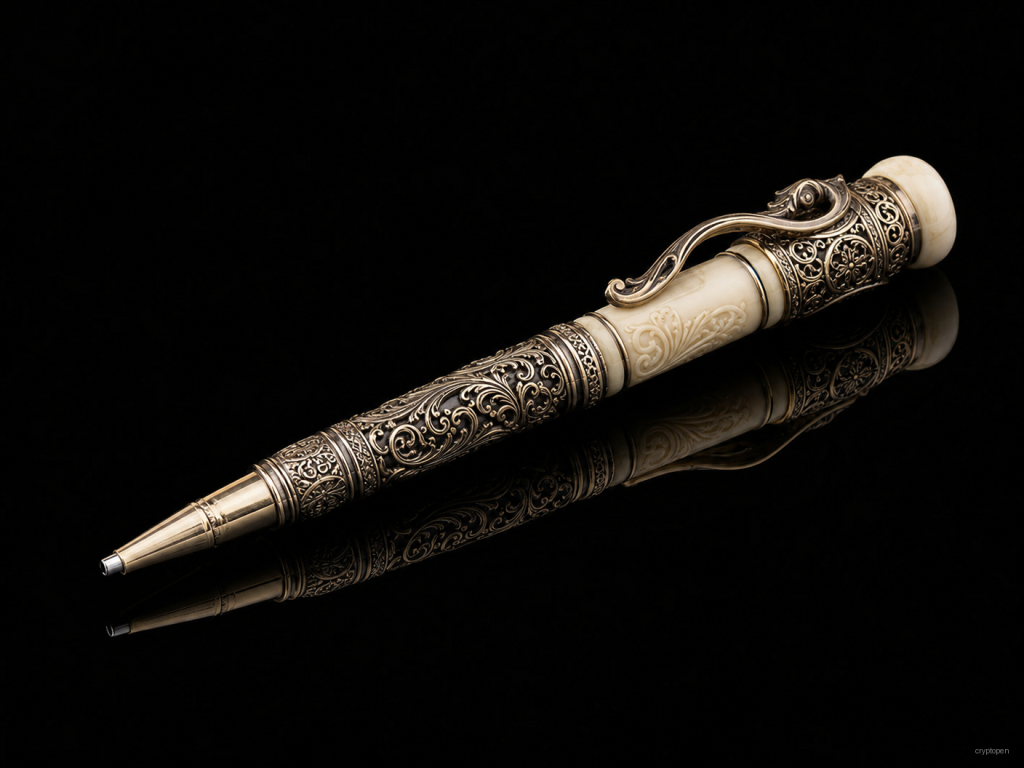
The Renaissance Script Writing Pen’s design draws from the aesthetic vocabulary of its inspiration era. The barrel features subtle fluting inspired by classical Roman columns, executed in warm amber-colored resin that evokes the honey-toned wood and ivory materials used in Renaissance luxury objects. Bronze-toned trim references the metalwork of Renaissance craftsmen, and the clip is engraved with a stylized botanical motif in the Renaissance tradition of natural ornament.
The proportions of the pen are deliberately classical — longer than most contemporary fountain pens, with a diameter that feels comfortable for writers using the traditional closed-fist grip characteristic of historical Italian handwriting. This grip, with the pen held between the index and middle fingers rather than between the thumb and index finger, was standard in Renaissance writing practice and is still recommended for Italic calligraphy.
Nib Performance for Historical Scripts
The Renaissance Script Writing Pen’s italic nib is ground to precise specifications derived from the study of historical writing instruments and the scripts they produced. The cut width — available in 1.1mm, 1.5mm, and 2mm — corresponds directly to the proportions used in authentic Renaissance manuscripts, ensuring that calligraphers using this pen can produce historically accurate letterforms at authentic scale.
The nib’s writing angle has been calibrated to require a pen-to-paper angle of approximately 45 degrees — the angle described in Renaissance writing manuals as optimal for Italic script. This built-in guidance helps calligraphers develop the correct habit naturally, reducing the need for the constant angle-checking that can interrupt the flow of practice.
Authentic Material Choices
The Renaissance Script Writing Pen uses an ebonite feed — historically accurate material — rather than the modern acrylic or plastic feeds used in mass-produced pens. Ebonite regulates ink flow with a consistency that responds well to the particular demands of broad-edge calligraphy, where the nib must sometimes be held at angles that challenge the feed’s ability to maintain consistent delivery. The ebonite’s natural properties make it the ideal choice for an authentic Renaissance writing experience.
Inks for Renaissance Practice
To truly inhabit the spirit of Renaissance calligraphy, ink choice matters as much as pen choice. The Renaissance Script Writing Pen is beautifully paired with iron gall inks — the historical ink of choice for European scribes from the middle ages through the 19th century. These inks, made from ferrous sulfate and tannin extracted from oak galls, produce the characteristic warm black-brown tone visible in Renaissance manuscripts and have a chemical interaction with paper that makes the writing highly durable.
Modern iron gall inks are carefully formulated to be safer for pens than historical formulations, and the Renaissance Script Writing Pen’s materials have been tested for compatibility with the leading iron gall ink brands currently available. A small bottle of high-quality iron gall ink is included with the pen as an introduction to this authentic historical choice.
Educational Companion
The Renaissance Script Writing Pen is accompanied by an extensive booklet covering the history of Renaissance calligraphy, with reproductions of historical writing manuals and instructions for producing authentic Humanist Minuscule and Italic letterforms. Pen position, ink loading, paper preparation, and model alphabets are all covered in detail, making this pen an educational resource as well as a writing tool.
Who This Pen Is For
The Renaissance Script Writing Pen appeals strongly to calligraphers with a historical orientation — those who practice calligraphy not just as a contemporary art form but as a form of connection to the great tradition of Western lettering. It also appeals to historians, academics, museum professionals, and Renaissance reenactment enthusiasts who want an authentic writing experience. And it serves as an outstanding gift for anyone who loves history, art, or the intersection of the two.
Conclusion
The Renaissance Script Writing Pen is a genuine revival — not a nostalgic recreation, but a living connection to one of the most creatively productive periods in the history of the written word. Writing with it invites you into a centuries-long conversation between scribes, scholars, and artists about what beautiful writing can be and mean. For calligraphers who want to anchor their practice in history, this pen is an invaluable tool and a profound experience.
The Living Tradition
The Renaissance Script Writing Pen is available to a new generation of calligraphers who are discovering that the scripts of the past offer something that purely contemporary approaches sometimes lack: a depth of historical connection and a standard of aesthetic refinement that has been tested and proven across centuries of practice. By choosing this pen and engaging with the calligraphic traditions it represents, contemporary practitioners become part of a living tradition — not a museum piece, but a continuous thread of artistic achievement that they add to with each piece they create. The Renaissance Script Writing Pen is the tool through which that participation becomes possible.
Complete Your Practice
To complete your Renaissance calligraphy practice with the Renaissance Script Writing Pen, pair it with authentic iron gall ink, high-quality cotton paper with a slight tooth, and a dedicated practice time in a quiet, well-lit space. The combination of these elements — the right pen, the right ink, the right paper, the right attention — creates conditions in which Renaissance calligraphy can emerge in all its historical beauty. The pen provides the technical foundation; everything else is up to you.
